

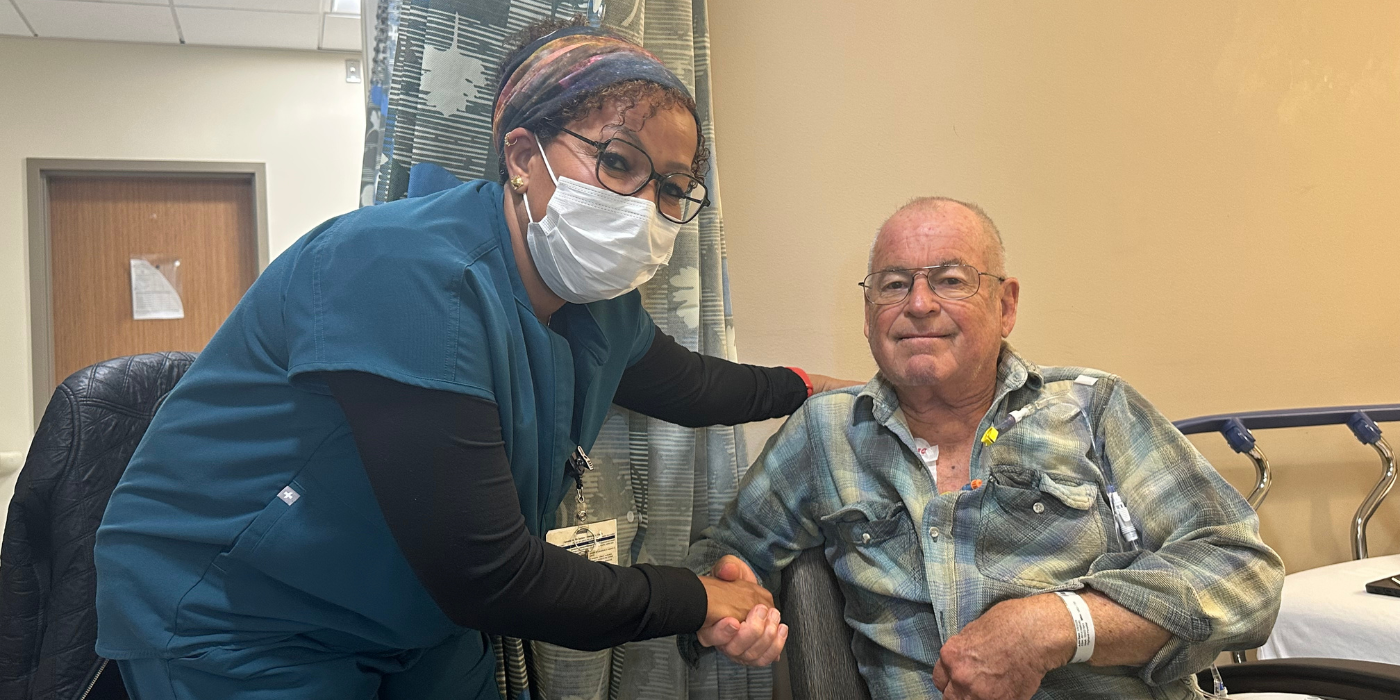
At 79, Alameda resident Bill Griesel has spent a lifetime making music. He first picked up the trumpet at age nine and has performed in jazz and big bands throughout his career. The same passion and resilience that has guided his music now sustains him through his colorectal cancer journey.
“When I got the diagnosis, I just wasn’t ready to give up,” said Griesel. “I wanted to do everything in my power to keep living a healthy and enjoyable life. This journey hasn’t been easy, but I’ve been surrounded by incredible care and support from everyone at Alameda Health System (AHS).”
Griesel began colorectal cancer screenings in 2018 under the care of his primary care physician, Evan Seevak, MD, at Eastmont Wellness. In 2025, a routine test revealed blood in his stool, leading to a colonoscopy and a diagnosis of rectal adenocarcinoma, a type of cancer that starts in the glands that line our organs.
He faced a difficult decision about surgery, which would require a permanent colostomy, a surgically created opening that allows waste to leave the body.
Emily Mirafor, MD, colon and rectal surgeon at the Wilma Chan Highland Hospital Campus (WCHHC), explained, “To remove Bill’s tumor safely and check whether the cancer had spread, we performed an abdominoperineal resection, a surgical procedure to remove the rectum, anus and part of the sigmoid colon.”
Colon and rectal cancers are among the more common cancers treated surgically at Alameda Health System (AHS). Miraflor works closely with colorectal surgeon Lucas Thornblade, MD, and the team performs many of these procedures each year. She shared that tumors in Griesel’s location are less common and require a complex operation that results in a permanent ostomy.
Recovery can be challenging, she noted, as patients must heal from major surgery while learning to manage daily life with an ostomy. With support from Flora Cabanayan, a clinical and ostomy nurse at Wilma Chan Hospital Campus (WCHHC) who helps patients manage their colostomy bag, patients like Griesel regain confidence.
Miraflor praised his attitude during recovery. “Bill accepted his diagnosis without question and was determined to do whatever it took to get through treatment,” she said. “Like most new ostomy patients, he had frustrating days, but with support he became confident in caring for himself. His positivity and trust in our team really helped.”
Griesel is now undergoing chemotherapy under the leadership of An Uche, MD, division chief of hematology and oncology. Even after surgery, microscopic cancer cells can remain, and chemotherapy helps reduce the risk of recurrence.
Uche said Griesel remains actively involved with his care team and actively uses MyChart to communicate and stay informed. “His positivity and engagement show how a strong patient-doctor partnership can make a real difference in recovery,” she said.
Music remains a part of his daily life. “I play the trumpet for about an hour each day,” he said. “It clears my mind and brings me joy.”
Though he no longer performs publicly, his long and rich career has included appearances throughout the Bay Area with the San Francisco All Star Big Band, the California Jazz Conservatory and at local Juneteenth celebrations.
Experiencing a health challenge that brought unexpected challenges, Griesel hopes his story encourages others not to delay screenings or ignore their health. “You never know what life might bring,” he said. “Take care of your health and don’t wait to get checked because it can save your life.”
As he adjusts to a new normal, Griesel continues to find strength in what has always sustained him. He now plays his trumpet about 45 minutes a day and has begun walking again along the Alameda shoreline.
“This journey has been full of ups and downs,” he said. “I’ve had to adjust to a life I never expected, but I’m grateful for every day. The care and support I’ve received from the people of AHS have made all the difference in helping me stay positive and keep moving forward.”
March is Colorectal Cancer Awareness Month, a time to highlight the importance of early detection, prevention and equitable access to screenings. Visit the Get Screened for Life website to learn more, including how Alameda Health System patients can schedule a screening.